
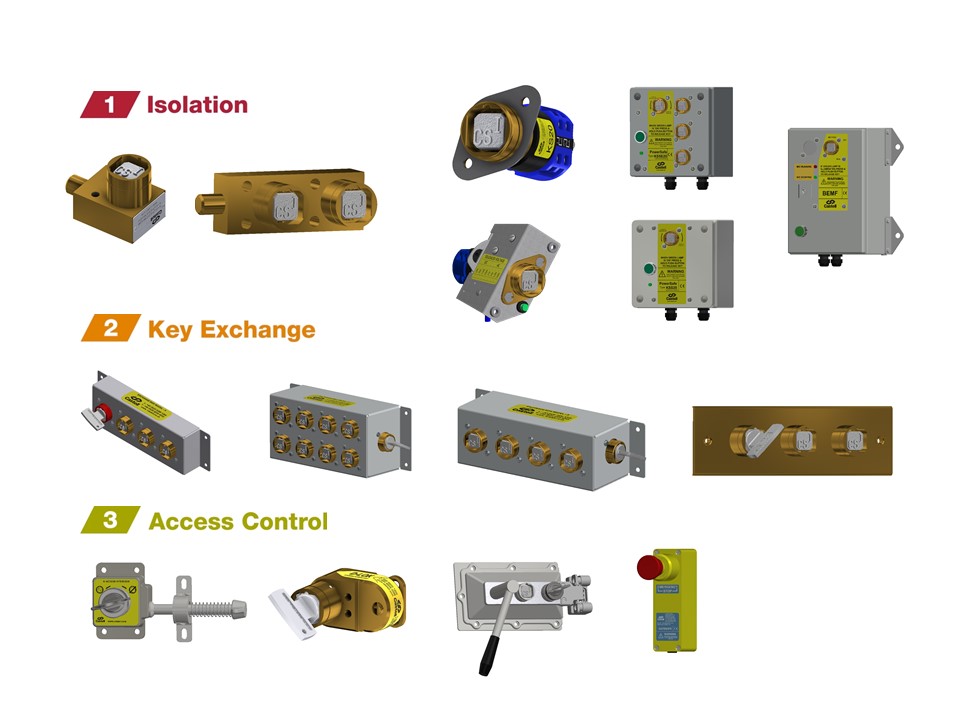
Access control refers to ways of controlling who can safely enter a hazardous area, usually involving machinery and electrical equipment, which can differ from one sector to another. In industrial environments there may only be one motor or machine that needs to be isolated before entering the hazardous area, whereas in the energy sector access control is often part of a system where all energy sources must be considered. Energy environments typically involve multiple power sources which all need to be in a safe condition before access is permitted to enter an area or open a switchboard panel. Through a sequential and uniquely identified trapped key interlocking (TKI) system, the isolation and the earthing conditions take place creating the conditions for a person to safely perform maintenance activities. The system allows for the integration of new and old equipment with interlocking solutions installed and operated by different contractors and personnel. Having a pre-determined sequential release system means you can remove the need to rely on written operation procedures alone. Typical examples of access control in the energy sector include wind farms, transformers, generator interlocking, data centres and substations. Benefits of TKI over alternative solutionsAlternative solutions to trapped key interlocking include electrical interlocking and lock out/tag out (LOTO). Electrical interlocking allows for the sequential operation of switches. On substations, an electrical interlocking scheme would allow for the operation of disconnectors. However, when maintenance activities are being performed, there is a need for a site controlled mechanical device. The mechanical device allows the site operative to complete the sequence and allows the release of a final authorisation key or permission to access key, which means that the sequence reversal is only controlled by site operatives. Lock out/tag out (LOTO) is a padlock-based safety procedure used to ensure dangerous machinery is correctly shut off and cannot be restarted prior to the completion of work in a hazardous area. LOTO gives the operator control over the environment they are working in and is an effective form of protection. It operates in conjunction with written operating procedures and signage to visually show the maintenance environment is protected; if the written operation procedures are not followed or signage not obeyed this can cause an unsafe environment on site. Trapped key reduces the need for written procedures alone to control the site safety system. Because LOTO is a non–sequential system when multiple energy sources are present there may be a need for greater site control. Implementing trapped key interlocking ensures that a process is followed and cannot be circumvented or short cut. The transfer of a key ensures that wherever personnel find themselves, in either starting or shutting down operations, they can be assured that they are safe. Wind farm interlockingWhen the wind turbine is running and generating electricity, the keys are trapped in the High Voltage (HV) and Low Voltage (LV) connections and access cannot be gained to the transformer which is usually housed in its own enclosure or room. The access lock on the transformer enclosure can only be opened when both the LV isolator and the HV circuit breaker are switched off, releasing the corresponding keys. The respective HV and LV keys are obtained from following the substations sequential trapped key release sequence. These keys are then inserted into a key exchange box releasing the trapped transformer housing key, which is in turn inserted into the Access Interlock (AI)to gain access to the housing. To return the transformer back into service the process is reversed. 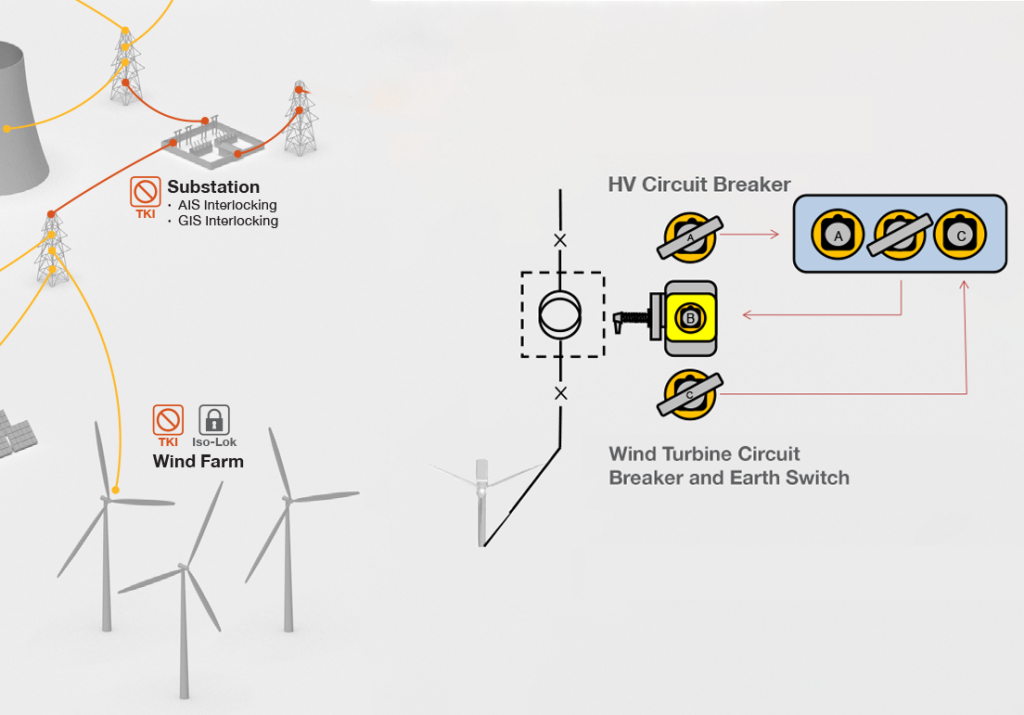 ConclusionAccess control in energy applications can be far more complicated than other sectors, owing to the fact that it is part of a larger site system with multiple energy sources. The uniquely identified trapped key system provides a full safety system to ensure safe access to a hazardous area. Castell have operated in the energy sector worldwide since the company’s inception in 1922. Castell products have safeguarded thousands of lives and ensured the safe operation of critical equipment allowing substations, wind farms, package subs & data centres to run efficiently and effectively with less down time and higher operational safety. Access control is part of most energy site safety systems and it allows the user to be in control of when the environment is safe to access and only that user can reverse the sequence to allow normal site operations. For this application, Castell offer a range of appropriate products. Isolation products include K locks, KSUPS, KS20, KSSE, KSS, BEMF, exchange products include exchange boxes and access products include AI locks, D locks, EDIX or Gatesafe (crash out system).
 To discuss any access control energy requirements please get in touch with our team of experts: [email protected]